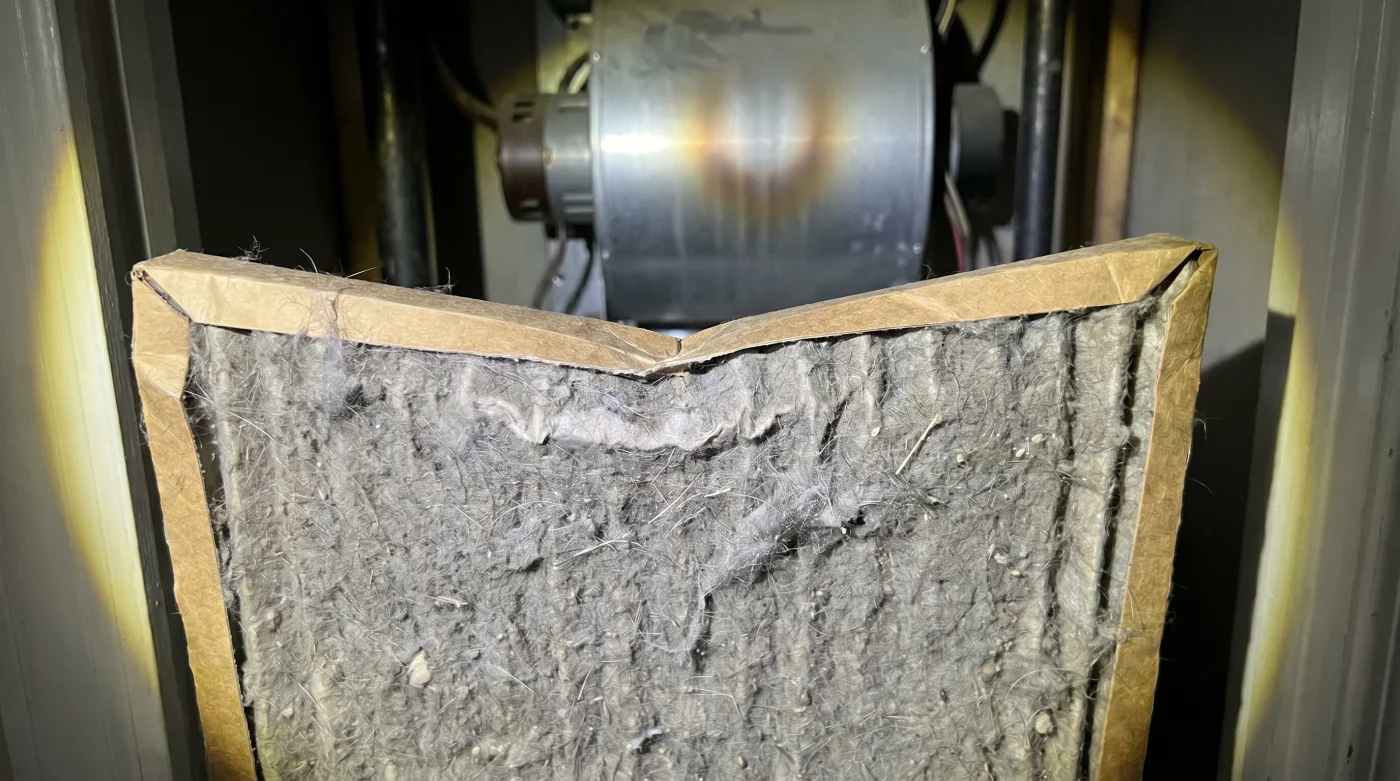
You stand in the dim light of your utility room, listening to the strained, vibrating hum of your furnace. Outside, the early November frost is just starting to harden the ground, and that familiar, faint scent of heated metal drifts through the vents. You hold a brand-new, tightly woven furnace filter in your hands, the cardboard frame boasting a hospital-grade density rating. You slide it into the narrow metal slot, confident you are protecting your home from every microscopic particle in the Canadian air.
But behind that cold steel panel, a quiet suffocation begins. The blower motor, designed to circulate air effortlessly throughout your living space, suddenly meets a wall of resistance. It whines, imperceptibly at first, working twice as hard just to pull a standard volume of air through those densely packed synthetic fibres. You are accidentally suffocating the very system meant to keep your family warm during the harshest months of the year.
We are conditioned to believe that more is always better. If a basic filter catches dust, a premium filter must catch everything, purifying our homes into sterile sanctuaries. Yet, the physical reality inside your ductwork tells a completely different story. The pursuit of absolute purity is creating an epidemic of premature mechanical failures across the country, silently burning out expensive blower motors while actually reducing the heating and cooling efficiency of your home.
The Wool Blanket Phenomenon
Imagine trying to run a five-kilometre race while breathing through a heavy wool blanket. Your lungs would burn, your heart rate would spike, and eventually, you would collapse from the sheer exertion of pulling oxygen through such a restrictive barrier. This is exactly what your residential furnace experiences when you install a high-MERV filter. It is forced to collapse from the sheer exertion of moving air through a brick wall.
The core myth of modern home maintenance is that your furnace is a whole-home air purifier. It is not. Your furnace is a pair of mechanical lungs, a sensitive system designed entirely around the principle of unrestricted circulation. When you insert a dense, allergy-grade filter into the return air slot, you immediately disrupt a carefully balanced equation of static pressure and volume.
The heat exchanger runs hotter than it should because the air moving across it is too slow to absorb the temperature. The motor runs hotter because it is constantly fighting a vacuum. The irony is staggering: in your attempt to improve indoor air quality, you are drastically shortening the lifespan of your equipment and driving up your utility bills. The mundane, cheap pleated filter—the one you likely skip over in the hardware store aisle—is actually your system’s greatest ally.
David Tremblay, a 48-year-old independent HVAC contractor from Winnipeg, keeps a grim collection in the back of his transit van. It is a stack of cracked, overheated blower motors he replaces every single winter. “Every one of these died gasping for air,” he notes, pointing to a scorched motor housing. “People spend forty dollars on a MERV 12 filter, leave it in for three months, and suddenly they are looking at a thousand-dollar repair in the dead of January.” David’s secret is simple: he only installs basic MERV 8 filters in his own home, changing them religiously on the first of every month.
Adjusting the Airflow Equation
The solution is not abandoning filtration altogether, but rather looking at your home as an ecosystem. You must balance the physical demands of your household with the mechanical limits of your furnace. It is about matching the right material perfectly to your specific lifestyle without compromising the lungs of your house.
- Lawn mower blades dull instantly if you ignore grass moisture
- Sump pump failures trace back to overlooked discharge pipe angles
- Cedar lumber prices drop when you buy off-season fence panels
- Cast iron skillet rust vanishes with this basic pantry acid
- Eavestrough downspouts freeze solid without a simple thermal break modification
For the Pet Parent
Golden retrievers and tabby cats produce a constant snowstorm of dander and hair. Instead of relying on a dense filter that will instantly clog and choke the motor, opt for a basic wire-backed pleated filter. The volume of fur will trap itself on the surface quickly, so you cannot wait three months between changes.
The goal is to catch the macroscopic debris before it hits the blower wheel. Change it every three weeks during heavy shedding seasons. This ensures your motor stays clean without restricting the cubic feet of air it needs to push warmth to your second-floor bedrooms.
For the Spring Allergy Sufferer
When the birch and maple trees release their pollen, the temptation to buy a premium micro-particle filter is incredibly strong. Resist it. Forcing your furnace to filter microscopic pollen will only cause the evaporator coil to freeze up when you turn on the air conditioning.
Instead, run a standard MERV 8 filter in the utility room to protect the motor, and place dedicated, standalone HEPA air purifiers in the rooms where you sleep and work. Let the standalone purifiers handle the microscopic irritants entirely while the furnace handles the heavy lifting of temperature control.
For the Older Home Resident
If you live in a house with aging ductwork, your system is already fighting friction. The metal pathways are likely slightly undersized for modern high-efficiency furnaces. Adding a dense filter to this equation is a guaranteed death sentence for an older, tired motor.
Stick to the cheapest, most breathable pleated filters you can find on the shelf. Your priority is purely preventative maintenance, focusing on keeping large dust out completely to protect the sensitive internal mechanical components from accumulating a thick layer of grime.
The Five-Minute Vitality Check
Protecting your furnace from premature failure requires a shift from reactive repairs to mindful, rhythmic maintenance. You do not need specialized mechanical knowledge, just a consistent physical routine that respects the machinery doing the work behind the walls.
Here is your tactical toolkit for unrestricted airflow. The physical steps are incredibly simple, but their impact on your mechanical systems will prevent sudden failure and ensure your house is never starving for adequate return air.
- The Light Test: Hold your new filter up to a ceiling light; if you cannot see the glow of the bulb through the material, it is too restrictive.
- The Rhythm: Buy basic filters in bulk, and write the date on the cardboard edge with a marker the moment you slide it in.
- The Whistle: Listen to your return vents; a high-pitched whistling sound means the system is choking.
If you run your thermostat fan to the ‘ON’ position rather than ‘AUTO’ to circulate air constantly throughout the day, downgrade to an even cheaper fibreglass filter. Constant circulation requires the lowest possible resistance to prevent the continuous running from burning out the fan bearings.
Taking five minutes on the first Saturday of every month to swap out a cheap, breathable filter is incredibly powerful. It is the most powerful preventative maintenance act that guarantees your basement remains warm and dry, your utility bills remain predictable, and your equipment survives.
A House That Breathes
When you stop treating your furnace as an air purifier and start treating it as the beating heart of your home’s climate, everything shifts. The strained noise of a struggling motor fades into a gentle, quiet background hum.
The hot spots and cold drafts in your living room begin to equalize. This happens because the conditioned air is finally moving at the designed speed, reaching the furthest corners of your home before it loses its heat or its chill.
You step away from the marketing pressure of buying the thickest, most expensive filtration block on the shelf. You embrace the mechanical truth that flow is always more important than restriction. A furnace needs to breathe just as much as you do.
By allowing your heating and cooling system to operate without an artificial bottleneck, you are not just extending its mechanical life. You are actively creating a more balanced environment for yourself, ensuring that the warmth of your home is always there when you need it most.
“The most expensive furnace in the world will destroy itself in a single season if you force it to breathe through a brick.” — David Tremblay, HVAC Specialist
| Key Point | Detail | Added Value for the Reader |
|---|---|---|
| Density Myth | High-MERV ratings restrict necessary CFM airflow. | Prevents a sudden $1,000 blower motor burnout. |
| The Sweet Spot | MERV 8 filters offer the perfect balance of protection. | Keeps dust out of the system without causing heat buildup. |
| Replacement Rate | Swapping cheaper filters every 30 days. | Lowers monthly heating bills by reducing mechanical strain. |
Practical HVAC Filter Questions
Why does my furnace overheat with an expensive filter?
A dense filter blocks the return air, meaning the heat exchanger cannot cool down fast enough, triggering the high-limit switch to shut the system down.Are cheap fibreglass filters safe to use?
Yes, they are excellent for airflow and protecting the motor from large debris, though you may need a separate room purifier for fine allergens.How do I know if my blower motor is struggling?
Listen for a whining noise from the basement, or place your hand over a vent—if the air feels weak but very hot, the system is choking.Can I wash and reuse my pleated filters?
No. Water destroys the structural integrity of the paper fibres and causes mould; always use a fresh, dry filter.What MERV rating is actually recommended by technicians?
Most residential HVAC professionals recommend MERV 8 for standard homes, as it protects the equipment without starving it of air.