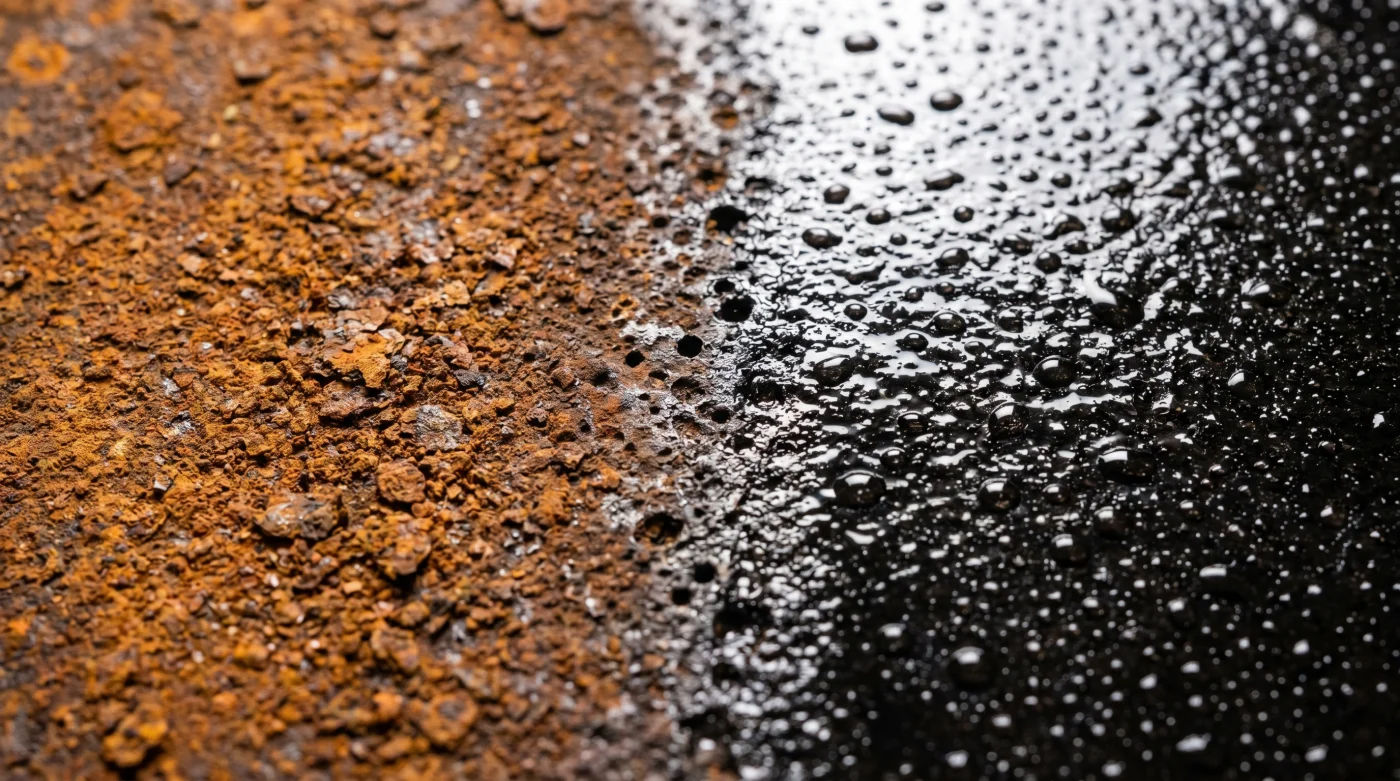
You pull the heavy skillet from the back of the cupboard, and your fingers drag across a textured, orange-brown crust. It smells faintly of old rain and neglected metal. This was supposed to be the workhorse of your kitchen, the pan that seared steaks perfectly on a Tuesday and baked cornbread on a Sunday. Instead, it feels like a heavy circle of failure.
You probably think the next step involves rolling up your sleeves, grabbing the stiffest wire brush you can find, and losing a Saturday afternoon to sweat and steel wool. Most people punish the base iron by scrubbing relentlessly, stripping away not just the rust, but the smooth, porous surface that actually allows the pan to hold its seasoning.
The reality of the abrasive method is harsh. It leaves your hands cramping, the air tasting of metallic dust, and the skillet’s cooking surface covered in microscopic scratches that will cause your next meal to stick stubbornly to the bottom.
There is a quieter, nearly effortless way to bring that pan back to life. Instead of fighting the oxidation with abrasive force, you can simply dissolve the metallic bond using nothing more than basic household acid. It is not about working harder; it is about letting chemistry do the heavy lifting while you drink your morning coffee.
The Chemistry of Quiet Restoration
Scrubbing rust is like trying to physically peel a shadow off a wall. Rust is simply iron oxide, a natural chemical reaction that occurs when ambient oxygen and moisture meet unprotected iron. It is not dirt. It is a structural transformation of the metal itself.
When you apply brute force, you are scraping away layers of healthy iron right along with the decay. Vinegar, however, acts as a gentle, persuasive mediator. The acetic acid slips seamlessly between the healthy metal and the oxidized crust, chemically separating the two without leaving tiny gouges behind in the valuable cooking surface.
This perspective shift changes everything. You stop treating the heavy pan like an adversary that needs to be dominated, and start treating it like a natural system that simply needs to be rebalanced through specific, calm actions.
- HVAC filter density ratings secretly choke residential furnace blower motors
- Lawn mower blades dull instantly if you ignore grass moisture
- Sump pump failures trace back to overlooked discharge pipe angles
- Cedar lumber prices drop when you buy off-season fence panels
- Cast iron skillet rust vanishes with this basic pantry acid
Up in Lunenburg, Nova Scotia, Elias Thorne, a 58-year-old marine mechanic turned antique cookware restorer, built a reputation on this quiet chemistry. He scours local estate sales for heavily rusted skillets that look ready for the scrap heap. Rather than firing up an abrasive sandblaster, Elias slides the orange pans into shallow plastic tubs filled with equal parts water and white vinegar, and quietly commands the rust to release. ‘You don’t fight the iron,’ he often tells his neighbours. ‘You just give the rust a reason to let go.’ He walks away, lets the acidic bath bubble softly for thirty minutes, and wipes away decades of neglect with a soft cloth.
The Triage of Pan Restoration
For the Thrift Store Gambler
If you just rescued a promising skillet from a neighbourhood garage sale and it is covered in a uniform, dusty layer of bright orange fuzz, you are dealing with flash rust. This is superficial and very easy to manage.
This condition requires the lightest touch. A brief, twenty-minute soak in a diluted acid bath will loosen that topical layer perfectly. You just need to monitor the soaking time closely to ensure the acid stops working exactly when the top layer of rust lifts away from the base.
For the Accidental Neglecter
You left the pan soaking in the sink overnight after a heavy dinner, and woke up to a tragic brown ring. The pan is entirely healthy except for one concentrated zone of moisture damage.
You do not need a full immersion for this. A simple targeted application—a paper towel soaked in vinegar laid flat against the affected area—will quietly lift the overnight mistake without stripping the perfectly good, black seasoning from the surrounding edges of the skillet.
For the Generational Heirloom
Perhaps you inherited a heavy, black skillet from a grandparent that sat in a damp shed or unheated garage for ten years. It is heavily pitted, deeply rusted, and feels rough to the touch.
This requires patience and incremental progress. You will need to submerge the piece, check it every half hour, and use a soft nylon brush to wipe away the loosened layers gently. It is a slow, methodical rescue operation, not a quick fix, requiring multiple short baths.
The Vinegar Immersion Protocol
Setting up this restoration is a calm, deliberate process. Clear your counter, find a plastic container large enough to lay the pan perfectly flat, and gather your supplies before you begin.
You want to avoid leaving the raw iron in the acid for too long, which can cause pitting. The goal is to separate the oxidation, wipe it clean, and immediately dry the raw metal to prevent new rust from forming in the air. By following these exact steps, you control the chemical environment completely.
- Mix equal parts plain white vinegar and room-temperature water (around 20 degrees Celsius) in a wide plastic basin.
- Gently lower the skillet into the bath, ensuring it is completely submerged to prevent an uneven water-line from etching the metal.
- Set a timer for exactly 30 minutes. You will see tiny bubbles forming; this is the rust separating.
- Remove the pan and immediately wipe the loosened sludge away with a soft sponge under cold, running water.
- Dry the pan bone-dry with a lint-free cloth, place it on the stove over low heat to evaporate any hidden moisture, and rub it immediately with a light coating of neutral cooking oil to seal the raw iron from the air.
Tactical Toolkit:
- The Acid: 5% acetic acid white vinegar (standard grocery store variety).
- The Ratio: 1:1 vinegar to water.
- The Limit: Never exceed one hour of total consecutive soak time.
- The Sealant: Grapeseed or canola oil for the immediate post-wash protective coat.
Reclaiming the Permanent Kitchen
In a kitchen filled with synthetic non-stick coatings that inevitably chip, peel, and end up in a landfill, a heavy iron skillet is a beautiful anomaly. It is one of the few cooking tools we own that actually forgives our neglect.
Understanding how to quietly repair this metal changes your relationship with the objects you own. You stop seeing a rusted surface as a permanent failure, and start recognizing it as a temporary chemical state. You realize that true quality does not mean something never tarnishes; it means the object possesses the inherent strength to be restored.
The next time you cook in that newly blackened, smooth pan, the heat will distribute evenly across a surface you saved. The food will release beautifully, not because of a factory-applied chemical spray, but because you took the quiet time to understand the metal.
You did not grind away the character of the pan. You simply wiped away the neglect, added a few drops of oil, and brought a piece of permanent culinary history back to your stovetop.
‘Rust is simply iron breathing in moisture; vinegar helps it exhale so we can seal it back into silence.’
| Key Point | Detail | Added Value for the Reader |
|---|---|---|
| Chemical Separation | Vinegar breaks the iron oxide bond without scratching the surface. | Preserves the smooth base metal for better non-stick cooking. |
| Controlled Immersion | A 1:1 ratio of water and vinegar for 30 minutes prevents pitting. | Ensures you safely restore the pan without causing acid damage. |
| Immediate Sealing | Applying neutral oil directly after washing stops flash rust instantly. | Secures your hard work and preps the pan for immediate re-seasoning. |
Frequently Asked Questions
Can I use pickling vinegar instead of standard white vinegar?
Pickling vinegar has a higher acetic acid content (usually 7% to 9%). If you use it, you must heavily dilute it with more water or cut your soaking time in half to prevent the stronger acid from etching the healthy iron.Why did my pan turn bright orange immediately after I washed it?
That is flash rust. Raw iron reacts with the moisture in the air almost instantly. To stop this, you must dry the pan immediately after rinsing and apply oil while the metal is still warm.Do I need to throw out the vinegar bath after one use?
If the bath is thick with brown rust sludge, yes, dispose of it down the drain with plenty of water. If you are doing multiple pans in one afternoon, you can reuse the same bath for a few hours.Can vinegar remove the old, sticky oil build-up too?
No, vinegar targets rust. To remove sticky, rancid oil (carbonized grease), you need an alkaline solution like lye or a baking soda scrub. Acid handles rust; alkaline handles grease.Will the pan be ready to cook with immediately after the vinegar bath?
No. The vinegar bath strips the pan down to bare iron. You must complete a full seasoning cycle in the oven with a layer of oil before cooking any food, or everything will stick.