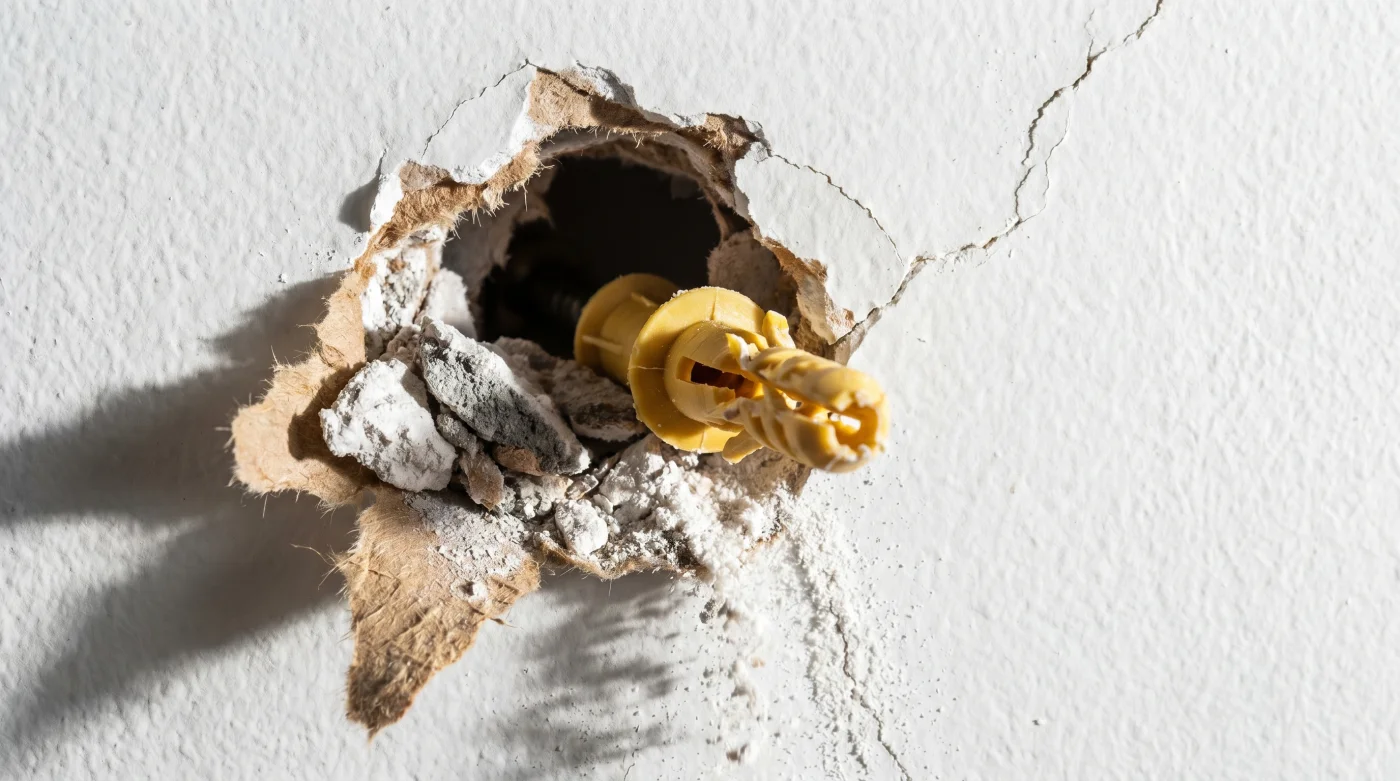
You hear the sharp, sickening sound of tearing paper just seconds before the crash. A heavy, brass-rimmed mirror sits awkwardly on the floorboards, surrounded by a quiet dusting of fine white powder. You are left staring at a jagged, fist-sized crater in the centre of your apartment wall, calculating the immediate cost to your damage deposit.
The glossy packaging on your hardware store fasteners promised they could hold fifty pounds without a flinch. Yet, you are learning the hard way that a static weight rating means absolutely nothing when gravity acts like a lever, pulling top-heavy frames forward and away from the vertical plane.
This is the silent, ongoing frustration of the modern renter. We crave the high-end designer look of floating oak shelves, massive art pieces, and heavy window treatments, but we are terrified of structurally ruining a space we do not own.
Most of us instinctively treat drywall like solid pine, twisting screws directly into it and hoping for tight friction. But standard wallboard is fundamentally just chalk sandwiched between stiff paper, and relying on basic friction in this powdery material is a recipe for sudden, messy failure.
The Snowshoe Principle of Wall Tension
Think about trying to walk across a frozen lake after a heavy January snowfall. If you step out in regular leather winter boots, all your body weight focuses downward onto the narrow heel. You punch right through the icy crust and sink to your knees.
Plastic expansion plugs operate exactly like those narrow winter boots. When you drive a screw into them, they bulge outward, relying entirely on pushing against soft gypsum to hold your bookshelf. When the shelf pulls down and forward, the plug simply tears through the weakened, crumbly material.
Now, imagine stepping onto that same snowpack wearing a wide set of traditional snowshoes. The downward force remains exactly the same, but your physical footprint expands dramatically. The fragile crust holds your weight with ease.
This is exactly the mechanical shift that occurs behind your drywall when you abandon plastic wedges and switch to steel toggle bolts. Instead of fighting the fragile gypsum from the inside out, they clamp behind the board, displacing the heavy weight safely across the wide, empty gap between the wooden studs.
- Gas stoves face massive phase-out as retailers shift to induction
- Fiberglass insulation shortages force builders toward mineral wool alternatives
- Pantry shelving depth creates dead zones where dry goods expire
- Sump pump failures occur because homeowners ignore the check valve
- Cast iron radiators require a specific boiled linseed oil treatment
Elias Thorne, a 42-year-old set designer working out of a drafty Toronto studio, builds temporary living rooms that have to look permanent on camera. He hangs massive antique mirrors and floating wood mantels on thin sheets of temporary drywall every single week. “People think the wall is weak,” Elias often explains to nervous art directors on set. “The wall is perfectly fine. You’re just stabbing it with needles instead of giving it a wide hug. A toggle bolt turns the hidden back of the drywall into a massive load-bearing surface.”
Adapting to Your Designer Ambitions
Not every piece of heavy decor requires the exact same hardware logic. The way you mount a deep floating bookshelf differs wildly from how you would safely secure a heavy, framed portrait.
For the Floating Shelf Purist: Floating shelves act exactly like diving boards. Every inch the shelf protrudes away from the wall multiplies the pulling force on the top screws. Here, ribbed plastic anchors are guaranteed to fail within weeks. You need strap toggles—often called snap toggles—that slide a solid metal bar completely flat against the back of the drywall.
For the Gallery Wall Collector: A cluster of small frames barely strains the gypsum. But if you have one large focal piece—like a solid oak frame—the top mounting wire pulls outward. Use a single toggle bolt in the centre to carry the absolute physical weight, while using smaller, simple wire brads to keep the bottom edges level.
For the Renter Fearing Deposits: The immediate, visceral fear of using a toggle bolt is the size of the required entry hole. Yes, you need to drill a half-inch hole to slip the folded metal wings through the wall.
But patching a clean, perfectly round half-inch hole on move-out day takes thirty seconds with a dab of lightweight spackle. Patching a blown-out, torn crater caused by a failed plastic plug requires mesh tape and sanding blocks, turning a quick exit into a weekend chore.
Executing the Hold with Precision
Proper installation requires a methodical approach and a little bit of patience. You want to actually feel the hardware engage with the hidden architecture of your room, rather than just twisting a screwdriver blindly.
Start by finding the exact placement for your object. Mark the wall softly with a pencil, stepping back across the room to ensure the height feels natural before you commit to the drill.
Here is your tactical toolkit for a permanent, renter-safe hold:
- One power drill with a 1/2-inch spade or twist bit.
- A high-quality stud finder (to avoid hitting solid wood, as toggles require the hollow cavity to open).
- Steel strap toggles or traditional spring toggle bolts.
- A damp cloth to immediately catch the falling gypsum dust.
Follow these precise motions to secure your hardware permanently. Drill your entry hole slowly to prevent the outer paper facing from tearing. Pinch the metal wings of the toggle flat against the threaded bolt. Push the assembly through the wall until you hear a distinct, metallic “click” as the wings snap securely open inside the hollow cavity. Pull the bolt slightly toward you so the wings bite into the back of the drywall, then tighten the screw slowly by hand until flush.
Avoid using a power drill for the final tightening phase. You want tactile feedback from the handle to know exactly when the metal sits perfectly tight against the paper backing without crushing the delicate chalk interior.
A Foundation of Confidence in Your Space
Modifying a rented apartment often feels like navigating a series of compromises. We settle for leaning our beautiful mirrors against the floorboards, and we hang our heavy winter coats on flimsy over-the-door hooks. We live in a quiet state of hesitation, fearing the structures around us because we do not truly own them.
But understanding the physical mechanics of the walls surrounding you changes that relationship entirely. You stop guessing, hoping, and crossing your fingers. Instead, you engineer a secure, reliable environment based on simple physics.
When you hang that heavy vintage mirror using the correct weight distribution logic, it ceases to be a liability. It transforms into a permanent, grounding fixture of your home, held firmly in place by a quiet, invisible strength. You can finally walk past it without waiting for the inevitable crash.
“Stop fighting the drywall’s fragility. Leverage its vast surface area instead, and your walls will safely carry almost anything you ask of them.”
| Key Point | Detail | Added Value for the Reader |
|---|---|---|
| Plastic Expansion Plugs | Creates outward friction inside soft chalk. | Best used exclusively for light picture frames under five pounds. |
| Traditional Toggle Bolts | Metal wings spring open in the hollow stud gap. | Safely displaces heavy loads across the drywall backing for absolute security. |
| Metal Strap Toggles | Solid metal bar zips tightly against the back wall. | Allows you to remove the screw later without losing the anchor inside the wall. |
Frequently Asked Questions
Will a toggle bolt hole ruin my damage deposit?
No. A clean half-inch hole is significantly easier to patch seamlessly with lightweight spackle than a jagged tear from a ripped-out plastic plug.Can I use a toggle bolt if I hit a wooden stud?
No. Toggle bolts require the empty, hollow space behind the drywall to open. If your drill hits solid wood, simply use a regular wood screw for the strongest possible hold.How do I remove a standard spring toggle bolt when moving out?
Simply unscrew the bolt. The metal wings will safely drop behind the wall into the hollow cavity, leaving only the neat, round hole for you to patch.Why do floating shelves always seem to tilt forward over time?
Floating shelves act as levers, pulling heavily and continuously on the top anchors. Toggle bolts resist this outward pulling force much better than friction-based plastic cylinders.Does the specific thickness of my apartment drywall matter?
Yes. Most Canadian residential apartments use standard half-inch drywall. Ensure your chosen toggle bolts specify they are threaded long enough to comfortably clear at least that thickness.